
The best mattress for lower back pain: what the research actually says
For most people with ordinary lower back pain, the research points to a medium firm, supportive mattress rather than a hard one: medium firm keeps the spine closer to neutral while easing pressure points, though the right bed is individual and a mattress is only ever one part of the picture.

You track your training, your food and your recovery, then spend a third of every day on a surface you have not thought about in years. If you wake up stiff and sore in the lower back and it eases once you are up and moving, your mattress is a fair suspect. Here is what the evidence actually says about beds and back pain, without the hype, so you can decide whether yours is helping or quietly working against you.
The firm mattress myth
The old advice to buy the hardest mattress you can find for a sore back does not hold up. In a 313 person randomised trial published in The Lancet, adults with chronic lower back pain who slept on a medium firm mattress had less pain in bed, less pain on rising, and less disability after 90 days than those on a firm one[1]. The reason is simple: your spine has natural curves, and a surface that is too hard cannot let your hips and shoulders settle, so your back muscles stay switched on all night trying to hold you in shape, and you wake up tight.
313
One honest note before we go further. Medium firm is a sensible default, not a cure, and the wider evidence says the best mattress is individual, with no single type proven right for everyone[3]. And if a sore back is what is driving your mattress choice, the most reliable guide is not a rule of thumb but a professional who knows your body: a chiropractor or physiotherapist can help you match firmness and support to your own back.
What "medium firm" actually means
On the usual consumer scale of 1 (very soft) to 10 (very firm), medium firm lands around a 6 or 7. That is the range that supports most people: heavy parts (shoulders and hips) sink in a little, lighter parts (the lower back and legs) stay supported, and the spine stays roughly level. It avoids the two extremes, the hammock sag of a bed that is too soft, and the pressure and gap of one that is too hard.
Support and comfort are two different jobs
It helps to separate the two, because a good bed needs both.
- Support comes from the core, usually a spring system or a dense foam base, and its job is to hold your body weight so you do not sink to the bottom. Pocket springs, which move independently rather than as one unit, contour to your shape and cut down on the bounce you feel when a partner moves.
- Comfort comes from the top layers, the foam, wool or latex you actually lie on, which relieve pressure on the joints.
A bed with support but no comfort feels like a cot; one with comfort but no support feels like quicksand. For many people a hybrid, a pocket spring core with quality comfort layers, gets the balance right.
Your sleep position changes the choice
Medium firm is the general guide, but how you sleep adjusts it.
- Side sleepers carry their weight on one shoulder and hip, so they need a surface that contours; too firm and the shoulder jams and the spine twists. A small pillow between the knees keeps the hips and spine aligned.
- Back sleepers usually do best on a true medium firm: enough push back to stop the hips sinking, enough give to fill the curve of the lower back.
- Stomach sleeping is the hardest on the back and neck, since it arches the spine and twists the neck; a firmer surface and a very thin pillow (or none) help, and easing toward side sleeping is worth trying.
When the mattress itself is the problem
Mattresses wear out, and an old one can quietly stop holding your spine level even with no visible dip. In studies by Jacobson and colleagues, people who replaced beds that were five years or older with a new medium firm mattress reported less back and shoulder pain and stiffness and better sleep[2]. As a rule of thumb, if your mattress is past about seven to eight years and you wake sore, it is worth assessing (our companion guide on how long a mattress really lasts goes deeper).
If you are a heavier or more muscular build
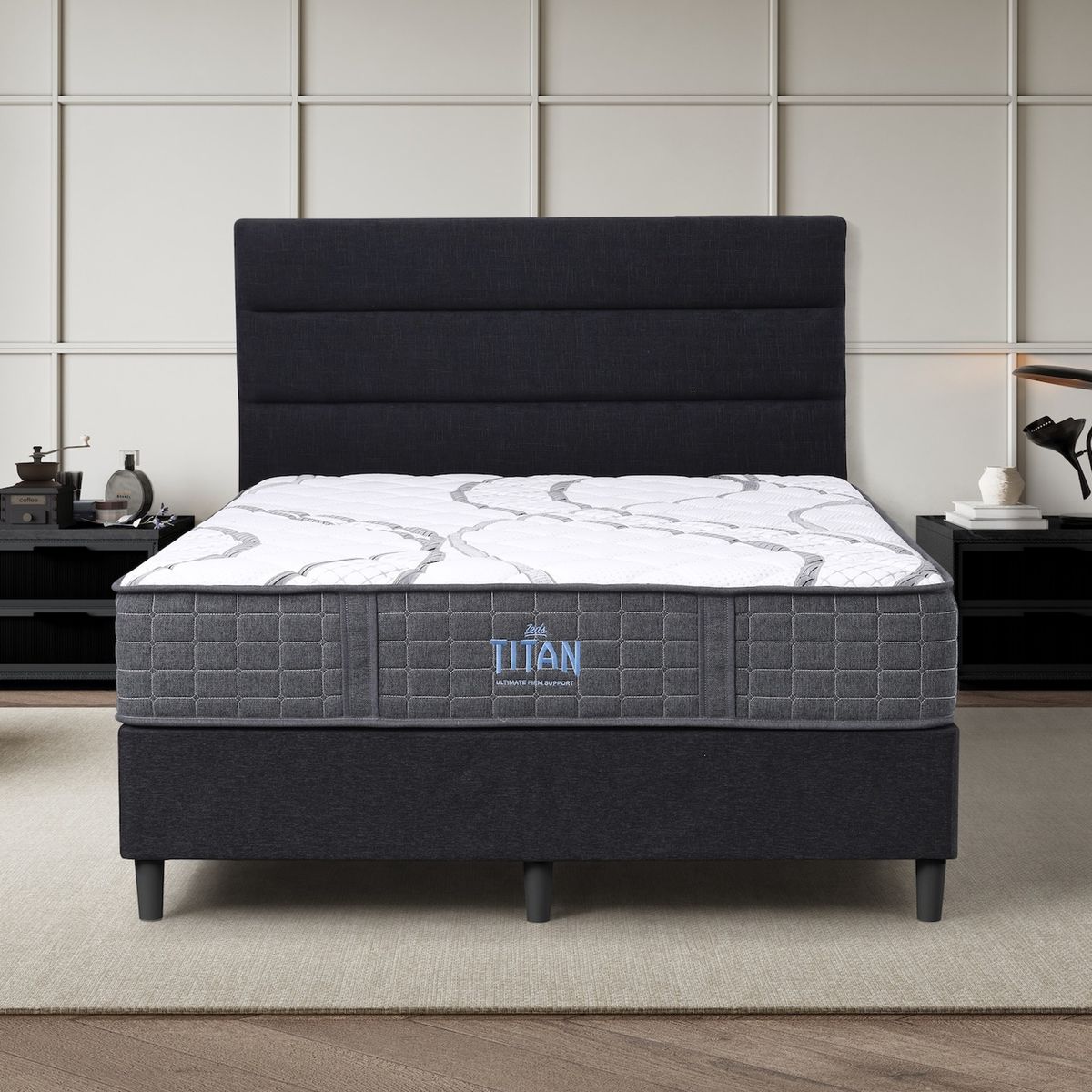
A heavier body puts more load on a mattress, and lighter foams can compress too fast and start to hammock. Larger people are better served by denser foams, reinforced edges for usable surface, and a robust spring unit. Dreamland’s Titan is built for exactly this, a reinforced support system designed to hold heavier bodies in alignment; it is the right tool for that job, not a promise to fix a sore back on its own.
Choosing well
- Try before you buy where you can: lie in your normal position for ten minutes, not a quick sit on the edge.
- Look for zoned pocket springs (firmer through the middle, where the hips load) and a comfort layer suited to your position.
- Ask about a trial period; bodies take a couple of weeks to adjust to a new surface.
- Do not ignore the pillow: it should fill the gap so your neck stays in line with your spine (thicker for side sleepers, thinner for back, very thin for stomach).
- If you share a bed, more space (a King or Super King) and good motion isolation mean fewer disturbances.
Where to find a supportive mattress
If your bed is old or fighting your alignment, a supportive medium firm mattress is one of the simplest changes you can make. Dreamland makes a range of supportive medium firm pocket spring mattresses, including the Titan for heavier builds. If a sore back is part of the picture, take a chiropractor’s or physio’s advice on the firmness and support that suit you, then test that feel in store.
Supportive medium firm mattresses
Browse the full mattress range or find your nearest stockist and try them in store.
For more, see our guides on how long a mattress really lasts and on what counts as a good night’s sleep.
Good to know
- Is a firm or medium firm mattress better for back pain?
- For most people with ordinary lower back pain, research favours medium firm over firm, because it keeps the spine neutral while easing pressure. The best choice is still individual, and serious or lasting pain needs a health professional.
- Can a mattress cause back pain?
- It can contribute. A bed that is too soft or worn out lets the spine sag, so the muscles work all night. A useful test: if you wake sore but ease within an hour of getting up, or you sleep better away from home, the mattress is a likely factor.
- Memory foam or springs for a bad back?
- Both can work; many people do best with a hybrid, a pocket spring core for support and airflow with foam comfort layers for pressure relief.
- How long should a mattress last before it affects my back?
- Around seven to eight years for most people; if it is older and you wake sore, it is worth assessing.
- Should I get professional advice on a mattress for my back?
- If a sore back is driving the decision, yes. A chiropractor or physiotherapist can match the firmness and support to your own body, which is more reliable than any general rule; then try that feel in store.
References
- [1] Effect of firmness of mattress on chronic non-specific low-back pain: randomised, double-blind, controlled, multicentre trial, The Lancet, 2003 Lancet RCT (313 adults): medium firm beat firm for pain in bed, pain on rising, and disability at 90 days.
- [2] New versus old bedding and sleep quality / back pain, Journal of Chiropractic Medicine / Applied Ergonomics (Oklahoma State University), 2006 Replacing beds 5 years or older with new medium firm bedding was associated with less back/shoulder pain (industry-supported, self reported).
- [3] What type of mattress should be chosen to avoid back pain and improve sleep quality? Review of the literature, Journal of Orthopaedics and Traumatology, 2021 Medium firm is generally best, but evidence is not strong enough to prescribe one type for everyone; the right choice is individual.
Researched and drafted with AI assistance, reviewed and fact checked by a named human.